
Most Startups Don't Need More Kubernetes Engineers
Why growing teams need an automated Kubernetes platform with repeatable deployments, built-in security, observability and cost controls.

3 min read
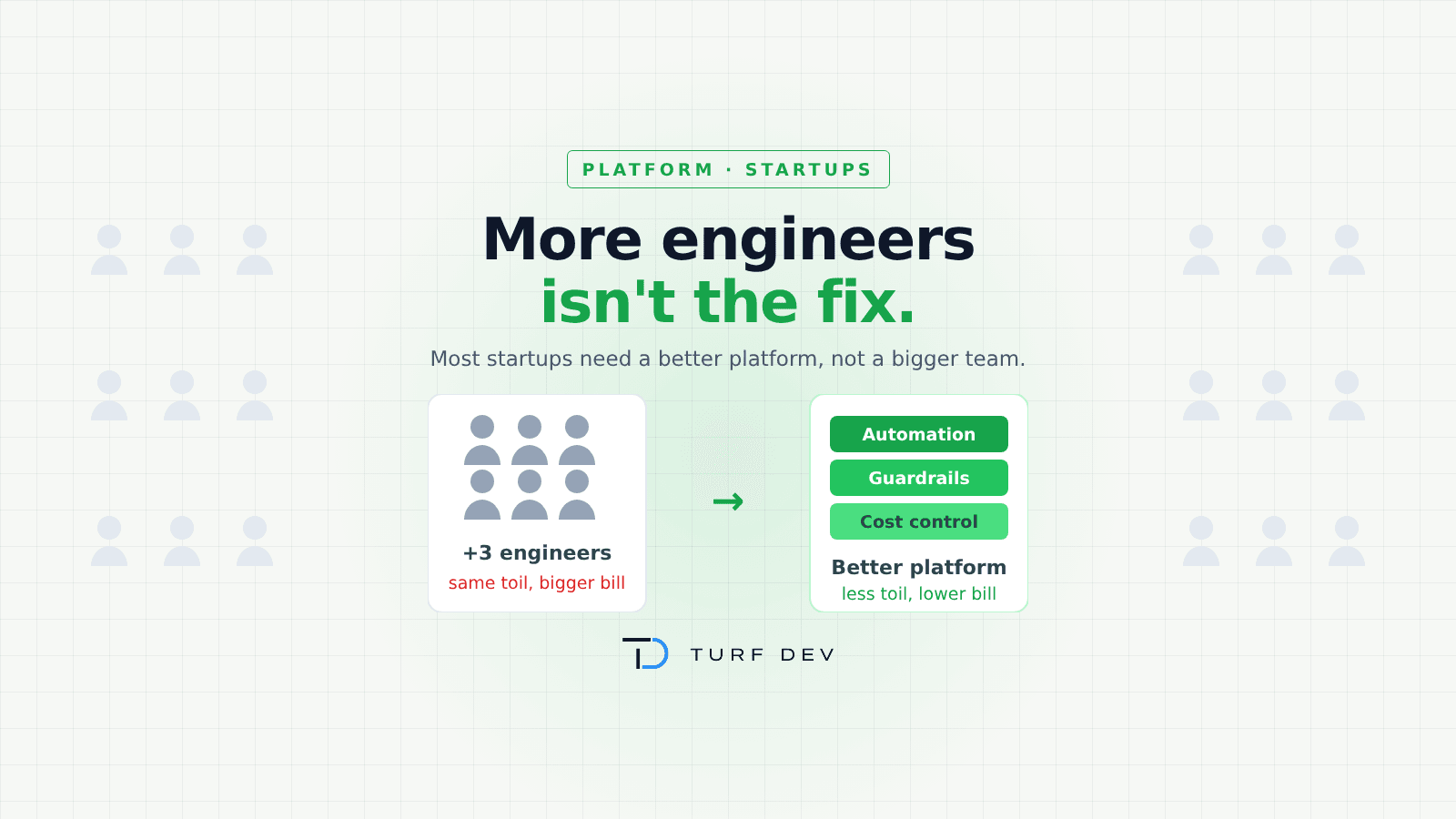
Most startups don't need more Kubernetes engineers. They need a Kubernetes platform that just works.
When a startup adopts Kubernetes, the cluster is the easy part. The weeks go into everything around it: deployments, pipelines, monitoring, security, backups. Each piece is another open-source tool to choose, wire up, upgrade and keep running.
The hidden cost of a do-it-yourself platform
A production-ready Kubernetes setup is not one tool. It is a stack of them, and every one needs an owner:
Deployments: GitOps or CI-driven releases that are repeatable and easy to roll back.
Pipelines: build, test, scan and promote images across environments.
Observability: metrics, logs and alerts that tell you something is wrong before customers do.
Security: policies, image scanning and access control.
Resilience: backups and a disaster recovery plan that has actually been tested.
Infrastructure as code: so environments can be rebuilt, not hand-repaired.
Each tool works on its own. The real work is making them work together, keeping them upgraded and fixing them at 2 a.m. when they don't.
Why hiring doesn't solve it
Adding engineers feels like progress, but it usually spreads the same toil across more people:
Platform work grows with the platform. More tools means more upgrades, more breakage and more on-call.
Product work still waits. Your strongest engineers end up maintaining infrastructure instead of shipping features.
Knowledge stays fragile. When the person who built the setup leaves, the platform becomes a black box.
What a startup actually needs
A startup needs a platform that is opinionated, automated and boring in the best way:
Opinionated: sensible defaults chosen once, so teams don't debate tooling for weeks.
Automated: deployments, scaling, certificates and backups happen without tickets.
Guard-railed: security and cost controls built in, not bolted on later.
Owned in code: everything versioned, reviewable and repeatable.
Meet Poorva Cloud
That is why we built Poorva Cloud, an opinionated Kubernetes platform engineering offering from Turf Dev. It gives teams a production-ready foundation out of the box:
Kubernetes foundations
GitOps-based deployments
CI/CD pipelines
Observability: metrics, logs and alerts
Security policies and image scanning
Backup and disaster recovery
Infrastructure as code
The goal is not to replace your engineering team. It is to remove the repetitive platform work that slows them down, so they can focus on the product.
Who it's for
Startups launching a SaaS product who need production-grade infrastructure from day one.
Teams modernising legacy infrastructure who want to move to Kubernetes without a long platform project.
Growing companies scaling a cloud platform who need reliability and cost control without tripling the ops team.
Let's talk
We are working with early customers now. If you are a founder, CTO or engineering leader building on Kubernetes and want your team shipping product instead of managing infrastructure, reach out at turfdev.in.
Discussion
Have a question or something to add? Share it below.
No comments yet. Be the first to join the discussion.